Common applications
Subject to approval for the dust hazard and operating conditions, inquiries may involve:
- Industrial dust collectors and filter housings
- Indoor or space-constrained process equipment
- Replacement venting assemblies and retrofits
Source flameless explosion vent assemblies for compatible dust collectors, filter housings and process equipment. These devices combine a venting element with a flame-arresting enclosure to help manage the release of flame during a deflagration. We help identify appropriate supplier options and request quotations based on your application requirements.
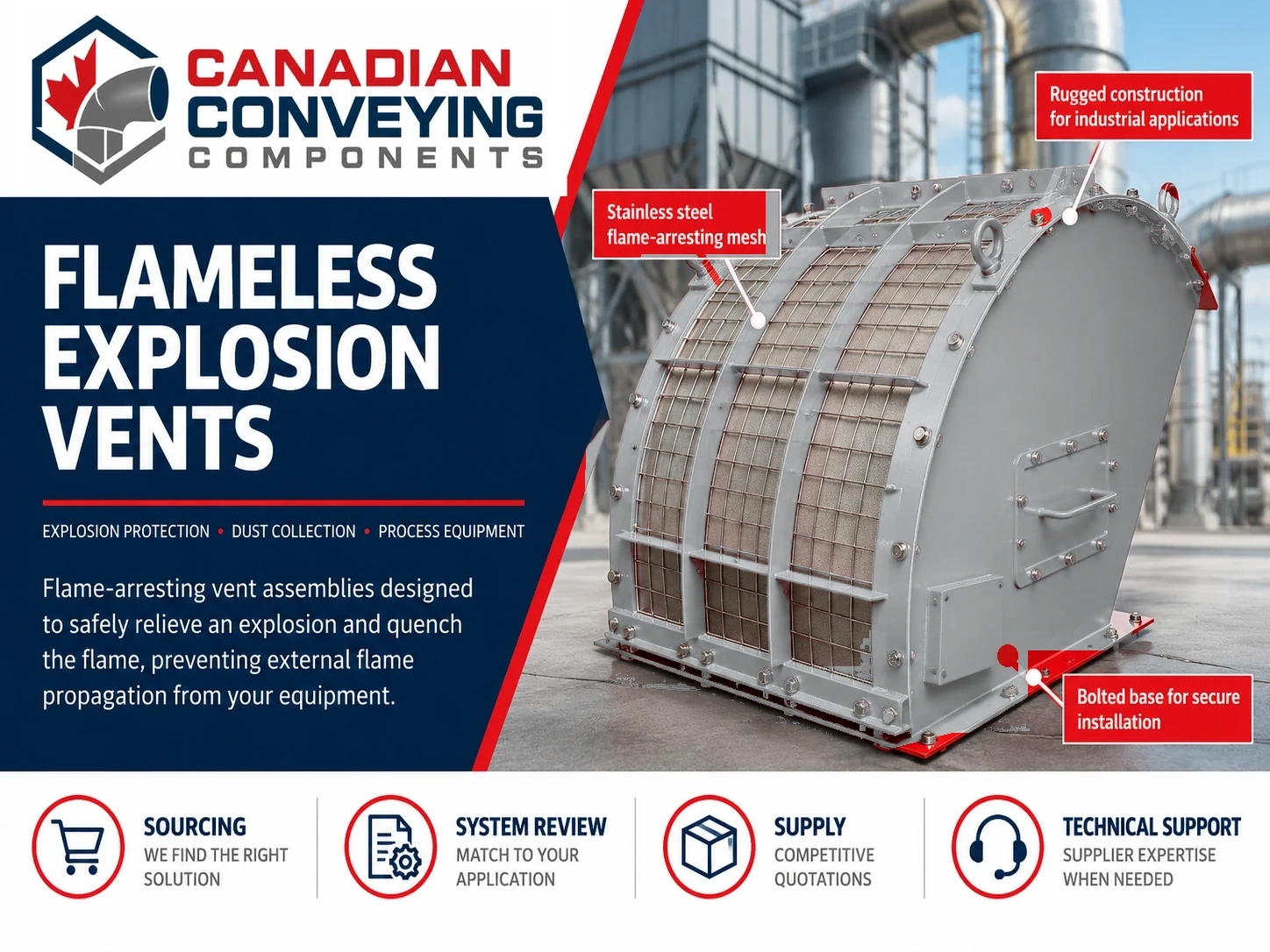
Illustrative product artwork, not a specific certified manufacturer model. Appearance, ratings, materials and mounting details vary. Confirm the exact product and installation with the manufacturer.
A flameless vent must be sized and approved for a specific deflagration-venting application. The vent relieves internal pressure while the flame-arresting section is designed to cool and suppress the emerging flame. These products may be considered where a conventional open explosion vent cannot be discharged directly outdoors, subject to manufacturer approval and a properly defined safe area.
Subject to approval for the dust hazard and operating conditions, inquiries may involve:
Product designs vary, but may include:
Suitability depends on the documented design and limitations for the selected model:
Flameless vents address the discharge of flame from a compatible vented enclosure; they do not automatically prevent explosion propagation into connected ductwork. Pressure, heat, gases, dust and other effects can remain, and a manufacturer-defined exclusion or safe zone may still be required—even for an indoor installation. Product sizing, applicability, certification and installation must be determined by the equipment manufacturer and qualified explosion-protection professionals. Canadian Conveying offers component sourcing, not independent protection-system design or certification.
An existing nameplate, drawing or manufacturer's reference is useful for replacements. New installations require a supplier-supported technical review.
Identify the dust collector, vessel or process equipment, including manufacturer, model, volume and available mounting area.
Provide vent-panel dimensions, model, opening pressure, mounting arrangement and available drawings or product documentation.
Share the material handled and available combustible-dust test data, including Kst, Pmax and other parameters used in the hazard assessment.
Include process pressure or vacuum, temperature, dust loading, airflow and any unusual or corrosive service conditions.
Show the proposed installation, indoor or outdoor location, nearby personnel routes, clearances, access and permitted discharge area.
State quantity, delivery location, desired timing and whether this is an exact replacement or a new application requiring manufacturer review.
Published ratings or certifications apply only to the listed device and approved conditions. No particular supplier affiliation, model availability, lead time or certification is implied by this page.
Important differences and sourcing considerations for flameless explosion vents.
A compatible venting element opens during a deflagration while a specially designed flame-arresting section is intended to cool and suppress the vented flame. Residual pressure and other discharge effects must still be considered in the system design.
Some systems are intended for indoor use, but only within the manufacturer's approved scope and with an evaluated safe area, clearances and installation conditions. Indoor use is not automatically suitable for every dust or process.
No. A flameless vent suppresses flame exiting a vented enclosure; a deflector guides vent discharge toward a specified direction; and an isolation device addresses propagation through connected process equipment. They do not substitute for one another.
A substitution requires verification of vent performance, equipment compatibility, hazard data, mounting dimensions and manufacturer approvals. Similar external dimensions alone are not enough.
Yes. Send the available equipment and vent details. We can review suitable sourcing routes, contact suppliers and obtain quotations subject to confirmation.
Send the equipment information, existing vent details and dust data you have. We can help coordinate a supplier quotation for an appropriately specified component.
Explore related sourcing categories. Each product has a distinct role and must be selected within the overall protection strategy.