Supply scope
Typical items sourced in this category include:
- Two-way and multiport diverter valve assemblies
- Plug, wye and similar diverter styles
- Manual or pneumatic actuation with wear-aware material options
Source two-way and multiport diverter valves for routing bulk solids between pneumatic conveying lines. We can help identify supplier options for plug, wye and other diverter configurations based on your line size, conveyed material, pressure or vacuum duty and required actuation.
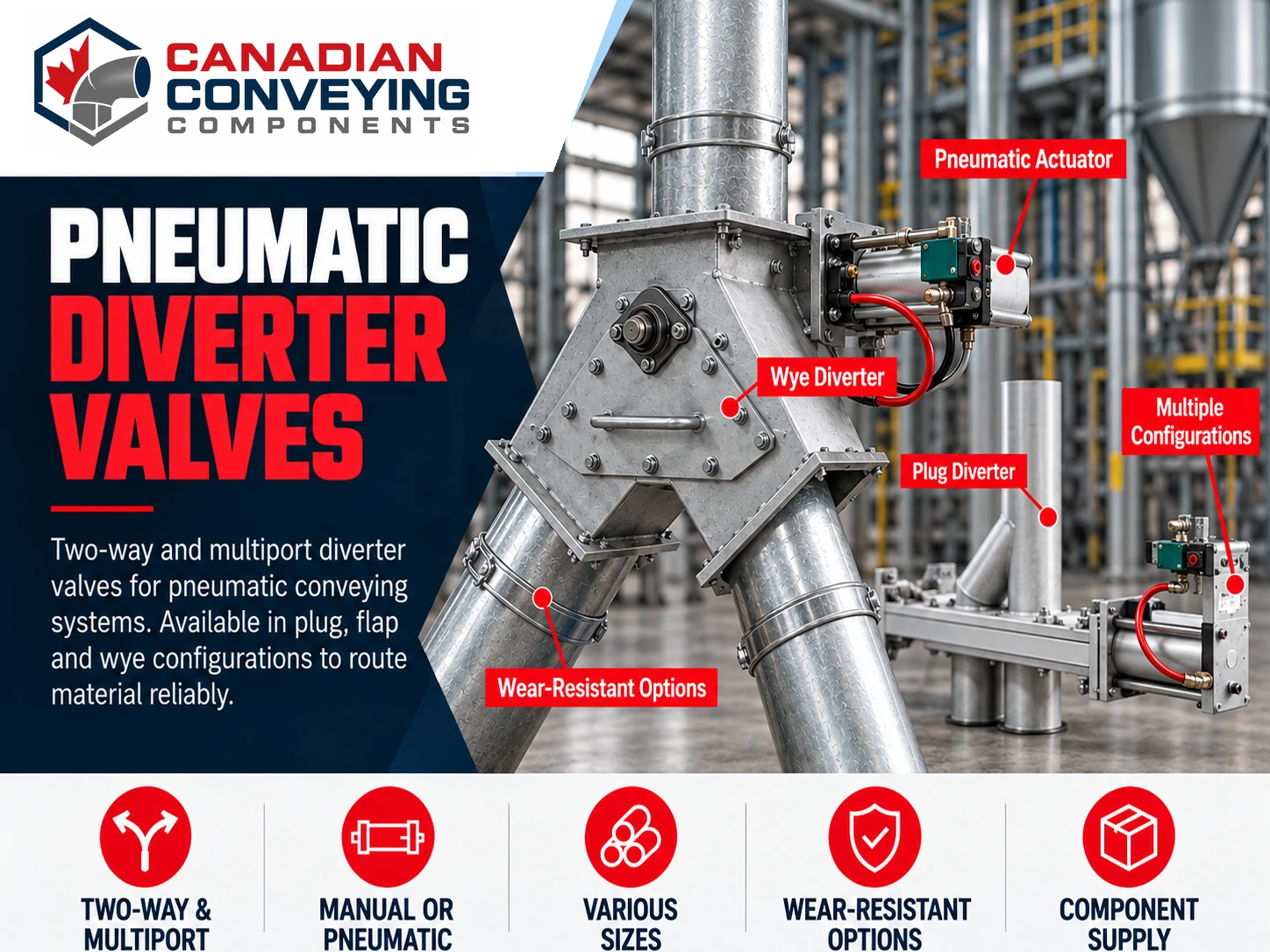
Representative product illustration. Valve body style, port geometry, seals, actuation and pressure ratings vary by manufacturer and must be confirmed for the exact duty.
These valves are not interchangeable solely by nominal line size. Routing, sealing and actuation requirements vary with the conveyed product and operating conditions.
Typical items sourced in this category include:
Examples of where these components are often used:
These details can speed up identification and quotation:
For replacement or new line routing, these are the details that most often determine whether a diverter is suitable.
Provide inlet and outlet count, switching arrangement, actual line dimensions, flange or pipe-end style, and installation orientation. Share a sketch when more than two destinations are involved.
Describe the material, bulk density, particle size, temperature, abrasiveness, expected throughput, and whether the line operates under positive pressure or vacuum.
Specify acceptable leakage, cross-contamination concerns, purge or seal-air arrangements (if required), housing material and any wear liners or sanitary construction requirements.
Confirm whether manual, pneumatic or electric operation is required, including supply power or instrument air, travel time, position indication and any interlocks.
A product-routing diverter is not automatically suitable for explosion isolation. Pressure ratings, permissible switching conditions, materials and any hazardous-area or combustible-dust requirements must be confirmed with the manufacturer and responsible system designer.
A model or nameplate, photographs of the ports and actuator, overall dimensions and operating details are useful starting points. The manufacturer must confirm compatibility before ordering.
Some models are designed for particular pressure or vacuum services, but suitability depends on their rated differential pressure, seals, product and operating cycle. Supplier documentation is required.
That depends on the selected valve's design and manufacturer instructions. Do not assume that an existing or proposed diverter can switch under active material flow without verification.
If you have a part number, photo, drawing, nameplate or rough dimensions, include them. For application-sensitive equipment, the material handled and operating method also help.
Explore adjacent product categories and supporting resources.