Southwestern OntarioServing Canada & U.S.
HomeComponentsAC Flow Tubes & Inline Ionizers
Static control • Pneumatic conveying • Component sourcing

AC Flow Tubes & Inline Ionizers

Source inline ionizing flow tubes used in compatible handling and conveying lines to neutralize static charge on moving material. These assemblies can help reduce clinging and unwanted build-up in product-transfer applications.
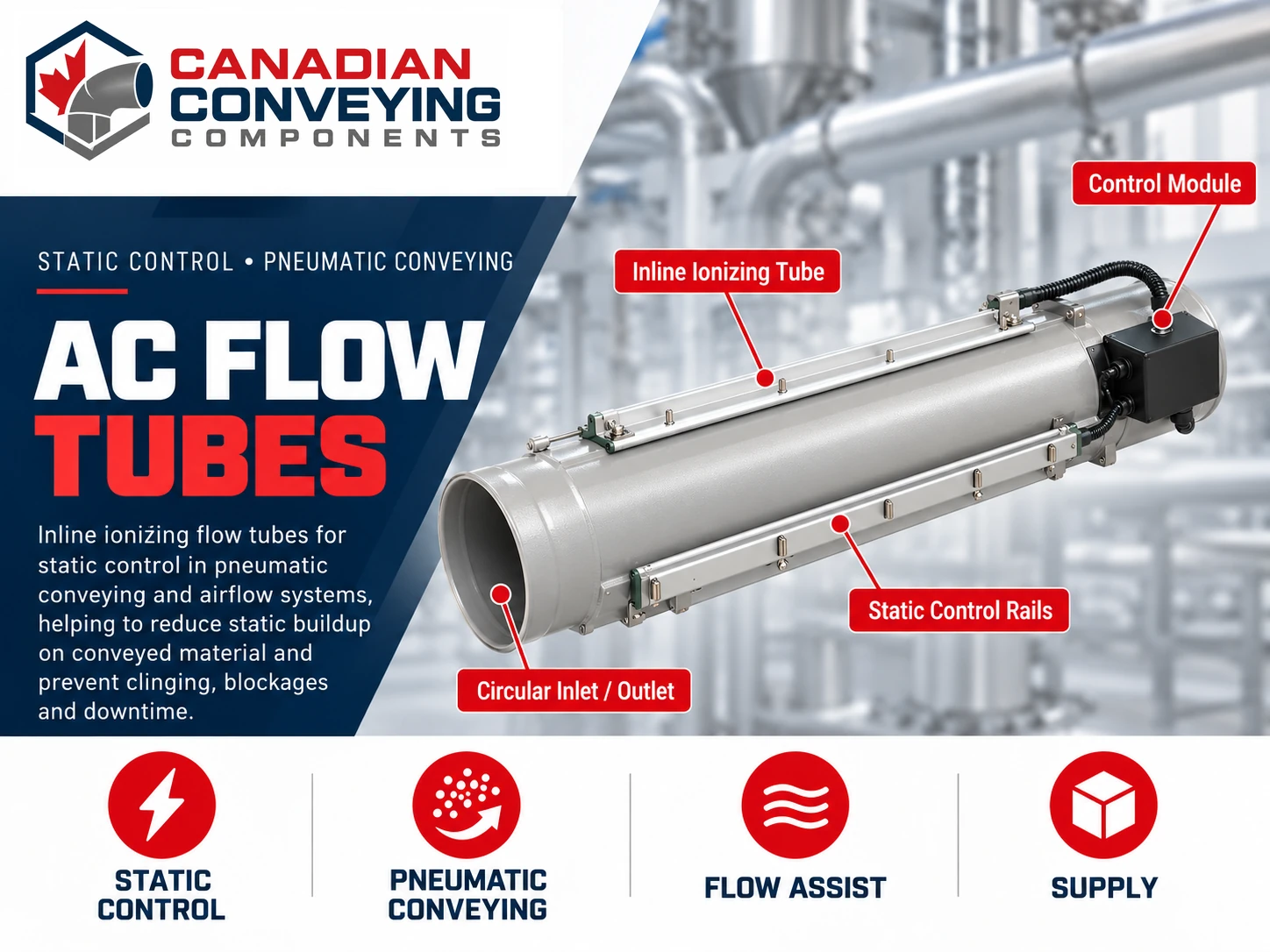
Canadian Conveying concept rendering of an inline AC ionizing flow tube with external static-control rails, circular tube ends and control module

Representative equipment illustration. Tube diameters, ionizing assemblies, power requirements, approvals and configuration vary by manufacturer and duty.

Inline static neutralization for material movement

Static electricity can make some materials cling to internal surfaces, accumulate in transfer paths or discharge inconsistently. Suitable ionizing tubes are designed to reduce electrostatic charge as material passes through an in-line section.

Static-control flow tube, conceptuallyConceptual inline ionizer with airflow through the tube and static-charge symbols; not a certified product design+−+−+PROCESS FLOWIONIZING ZONE · CONCEPTUALNOT EXPLOSION ISOLATION

Static neutralization does not provide explosion isolation or combustible-dust protection.

Ionizing flow tubes

Assemblies may feature a circular product passage, external ionizing elements and an electrical control or power supply.

  • In-line tube configurations
  • AC static-control assemblies
  • New units and matching replacement equipment

Industrial applications

Depending on the specific model and approval, systems may use inline ionizing devices to address static on material handling and conveying lines.

  • Static-related product cling and hang-up
  • Granular, fibrous or lightweight product streams
  • Material transfer and process equipment connections

Product sourcing

Start with the existing manufacturer and model, or send details of the process so compatible options can be explored with suppliers.

  • Tube diameter, length and connection style
  • Material characteristics and flow conditions
  • Electrical supply and access requirements

Need this component? For a replacement, send the make/model, tube size or nameplate. For a new application, describe the material and static problem.

Start an ionizer inquiry →
Important: static control is not explosion isolation.

An ionizer can help neutralize charge, but it does not replace dust-hazard assessment or explosion prevention and protection systems. The selected model must be approved for the material, airflow, installation conditions and electrical environment; combustible-dust and hazardous locations require particular care.

Details that help us source the right flow tube

A photo, label or part number is a useful starting point. For a new application, these details help narrow down relevant supplier options.

Material & problem

Describe the conveyed material, where clinging or accumulation occurs, and whether the issue is static-related, mechanical or uncertain.

Tube dimensions

Provide the line’s inside diameter, available installation length, connection details and mounting orientation.

Airflow & throughput

Include conveying airflow or velocity, solids throughput, temperature and operating pressure where known.

Electrical & controls

Identify power availability, existing ionizer electronics, wiring constraints and any required controls or indicators.

Operating conditions

Note dust-hazard classification, moisture or washdown requirements, cleaning procedures and material compatibility constraints.

Replacement identification

For an existing unit, send nameplate and component photos, original part number, quantity and delivery location.

Not all ionizing tubes are interchangeable. Configuration, process suitability and any proposed substitutions must be checked against supplier documentation.

Frequently asked questions

Common considerations when replacing or specifying industrial in-line ionizers.

What is an AC flow tube?

It is a tube or conveying section equipped with ionizing elements to reduce electrostatic charge on materials passing through it. That can help with clinging or accumulation in suitable applications.

Can it be used in pneumatic conveying?

Some models are intended for appropriate conveying duties. The actual application must be checked against the manufacturer's limits for airflow, material, installation and electrical requirements.

Can I replace one brand with another?

Possibly, but equivalence cannot be assumed. Pipe size, ionization method, controls, electrical ratings and operating conditions must be evaluated.

Does static neutralization provide explosion protection?

No. It does not substitute for a documented combustible-dust hazard analysis, ignition prevention measures or engineered explosion protection.

Can Canadian Conveying source from a photo or part number?

A clear photo, nameplate or part number is often the best starting point. Availability and technical compatibility still require supplier confirmation.

Need an AC flow tube or inline ionizer?

Send the existing model, a photo or basic installation details and we'll help coordinate an appropriate sourcing inquiry.

Tube diameter and connection style
Material, airflow and conveying method
Electrical requirements and existing model
Quantity, destination and timing

Related conveying components

Inline static control may be part of a broader material-transfer, process piping or pneumatic-conveying modification.