Southwestern OntarioServing Canada & U.S.
HomeComponentsVibrating Bin Dischargers
Bulk solids • Flow promotion • Bridging & ratholing

Vibrating Bin Dischargers & Bin Activators

Find vibrating bin dischargers and bin activators for more reliable bulk solids movement from storage bins, silos and hoppers. These vibratory assemblies can help address bridging, ratholing and inconsistent gravity discharge. We coordinate equipment inquiries using your material properties, bin geometry and downstream feeding requirements.

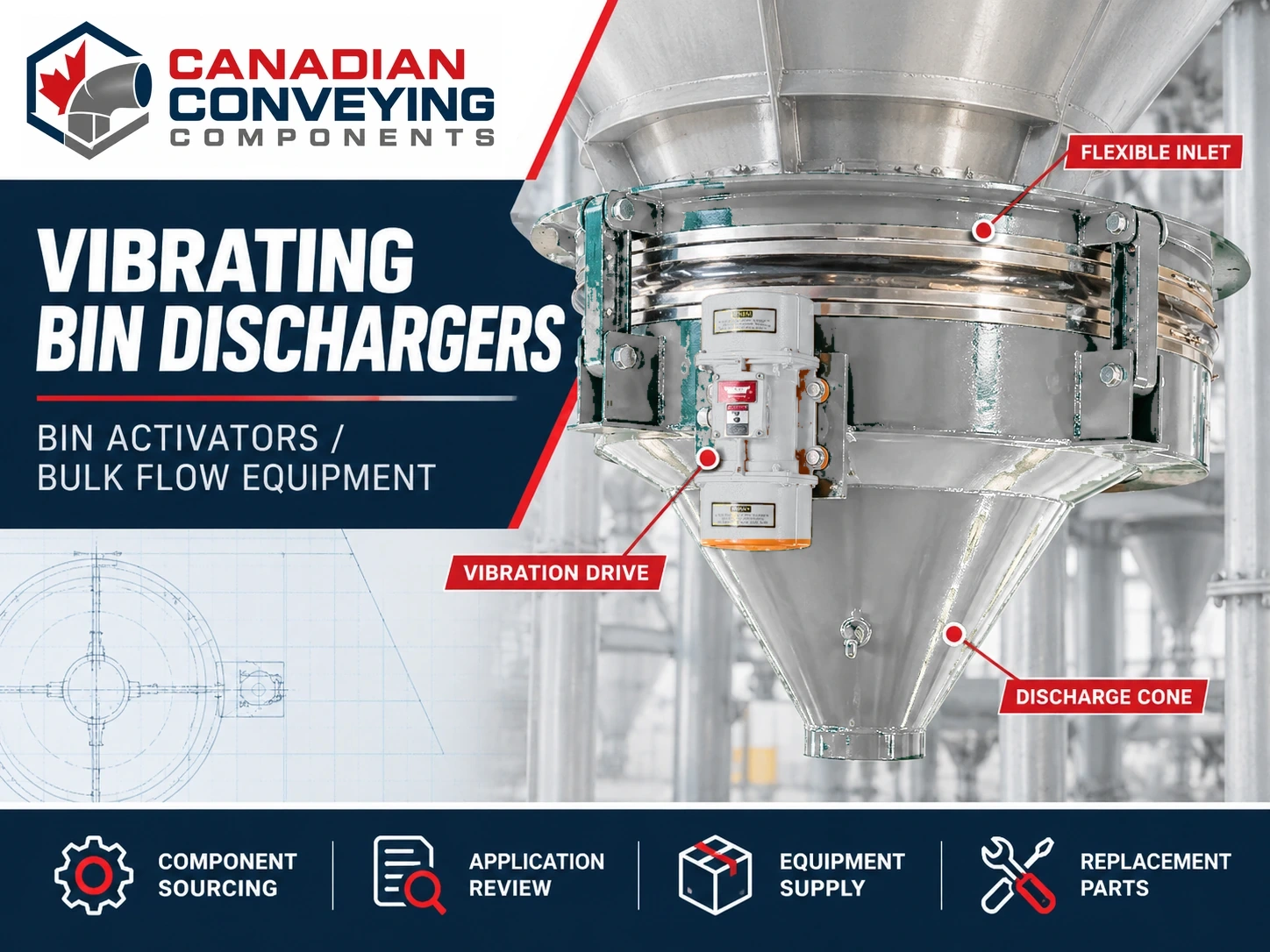
Vibrating bin discharger and bin activator showing flexible inlet connection, vibration motor and tapered discharge cone

Representative equipment illustration. Final bin connection, discharge arrangement, dimensions, construction and suitability are subject to supplier confirmation.

Vibrating bin discharger sourcing

A bin activator is selected for its material and vessel—not simply by the outlet diameter. We help organize the application details a supplier needs to recommend suitable equipment.

Equipment & component options

Discuss requirements for:

  • Vibrating bin dischargers and bin activators with tapered outlets
  • Vibratory motors, flexible inlet seals, suspension and adapter connections
  • Outlet fittings, replacements and supplier-supported accessories

Typical applications

Potential uses include:

  • Dry bulk powders, granules and ingredients with difficult flow behaviour
  • Storage hoppers, silos and bulk material bins
  • Flow promotion above rotary valves, screw feeders and other metering devices

What suppliers need to know

Include as much as you can:

  • Bin diameter, hopper slope, outlet size and available headroom
  • Product, bulk density, moisture, particle size and flow problem
  • Downstream feeder, required throughput, power and operating conditions

Understanding bin discharge problems

Material properties and hopper geometry determine whether vibration is an appropriate approach. Correctly selected equipment can encourage solids to enter the discharge path more consistently.

Understand the flow problem firstBRIDGING / ARCHRATHOLINGFLOW PROBLEM

Simplified hopper examples; equipment suitability depends on material and vessel geometry.

Bridging

A stable arch of bulk material forms over the outlet, restricting or stopping discharge. Equipment selection depends on the material, outlet arrangement and loading conditions.

Ratholing

Material flows through a central channel while material near the walls remains stagnant. Flow-promotion equipment may help improve the drawdown pattern when correctly applied.

Flow promotion, not metering

A bin discharger encourages flow from storage. A separate feeder or flow-control device is normally used where a controlled discharge rate is required.

Have a part to source?Send a photo, part number or description — you don't need a complete specification to start.Start a quotation →

Key selection considerations

For replacements and retrofits, confirm vessel loads, existing supports, connection flexibility, clearance and downstream equipment before selecting a bin activator.

Bin & outlet geometry

Bin and hopper dimensions, supported material mass, inlet and outlet arrangement, mounting elevation, suspension points and available installation clearance.

Product flow behaviour

Bulk density, particle size distribution, moisture, cohesiveness, temperature, pressure and changes between batches.

Integration & maintenance

Isolation of vibration from surrounding equipment, flexible connections, motor voltage and controls, maintenance access and any hazardous-area requirements. Vessel support and structural changes need qualified review.

Information for a replacement or retrofit quote

A bin discharger is an integrated assembly. For an existing installation, the assembly envelope and support arrangement can matter as much as outlet diameter.

Existing assembly

Send the installed manufacturer's nameplate, assembly diameter, cone and outlet dimensions, motor information, flexible connections and photos of support hardware.

Stored material & desired flow

Identify the bulk solid, typical and maximum loading, bridging or ratholing behaviour, required discharge rate and any changes in moisture or particle size.

Site interfaces

Show supporting steelwork, outlet feeder, available headroom, plant power and controls, and any required sanitary or hazardous-area features. Installation and structural design remain separately confirmed.

Request a bin discharger quotation.

Send a sketch of the bin and hopper, describe your flow problem and identify the material being handled. For replacements, an existing equipment nameplate or drawing is particularly useful.

Photos or drawing of the storage bin and hopper outlet
Material properties, moisture and observed flow problems
Bin dimensions, downstream feeder and required flow rate
Existing model (if replacing), electrical supply and delivery location

Frequently asked questions

Useful answers when planning a vibrating bin discharger replacement or a new bulk storage application.

Are vibrating bin dischargers and bin activators the same thing?

The terms are commonly used for vibratory flow-promotion equipment fitted below a bin or silo to encourage bulk solids to discharge. Actual mechanical designs, installation details and operating characteristics vary by manufacturer.

Will a bin activator solve bridging or ratholing?

It may help, but no single device suits every material and hopper. The supplier needs the material flow behaviour, storage geometry and operating conditions before recommending a solution.

Does the bin discharger control feed rate?

Normally, no. Its primary purpose is to promote flow from the storage vessel. A separate screw feeder, rotary valve or other metering device typically controls the rate where required.

Can an existing silo or hopper be retrofitted?

Some installations can be retrofitted, subject to the support design, outlet geometry, available space, connections and vibration isolation. Structural modifications and installations require review by appropriate qualified parties.

Does a bin activator replace the rotary valve or feeder below it?

No. The bin activator primarily promotes discharge from storage; the downstream feeder or valve typically determines the controlled feed rate. Supplier review should consider both pieces of equipment.

What should be checked before retrofitting a bin activator?

The support structure, mounting loads, flexible interfaces, motor and controls, operating clearances and connection to downstream equipment. Installation modifications and structural design should be assessed by qualified parties.