Storage bins & tanks
Welded steel, smooth-walled storage bins and hopper-bottom tanks for dry bulk materials, including agricultural and industrial storage applications.
BULK STORAGE & MATERIAL HANDLING
Source welded steel storage bins, smooth-walled hopper-bottom tanks, industrial process bins and custom hoppers for bulk materials. We help coordinate supplier quotations based on your capacity, material, discharge arrangement and site requirements.
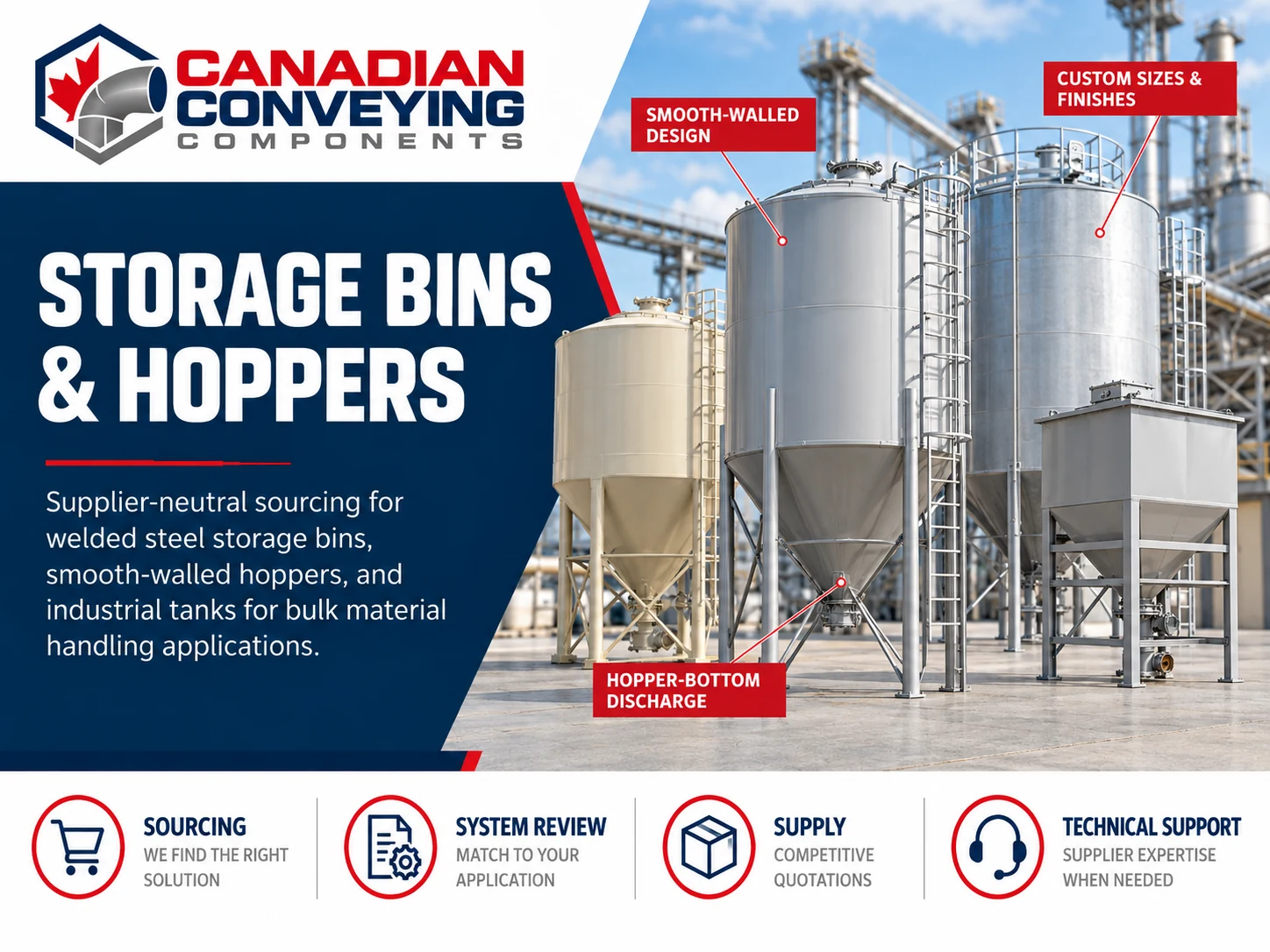
Supplier-neutral sourcing for agricultural and industrial applications, with options dependent on supplier capabilities and project specifications.
Welded steel, smooth-walled storage bins and hopper-bottom tanks for dry bulk materials, including agricultural and industrial storage applications.
Round, square or rectangular hoppers, with conical or other discharge arrangements selected for the material and downstream equipment.
Potential configurations include smooth-walled steel bins, hopper-bottom storage, custom industrial tanks and supporting discharge accessories.
Capacity, geometry, cone angle, outlet sizing and material-flow considerations should be reviewed for each application. Final engineering and code requirements must be confirmed with the responsible supplier or qualified professional.
Coatings, access ladders, manways, legs, outlets and integration with valves, feeders or conveying equipment may be available depending on the selected product and supplier.
We can help identify sourcing options, collect technical details and coordinate supplier quotations. Fabrication, structural design, installation and commissioning are separately scoped where applicable.
Quoting a vessel involves more than stating its capacity. An early application sketch helps suppliers review construction, discharge and site requirements.
Provide the required working volume or mass, units, bulk density range, filling rate, material characteristics and any changeover or contamination concerns. Capacity by weight depends on the product density.
Specify diameter or footprint, available height, hopper angle, outlet dimensions, fill connections, flow-aid requirements and the downstream feeder or conveying equipment.
Identify indoor or outdoor installation, local weather and seismic criteria where applicable, foundation or support arrangements, access requirements, coatings and relevant process hazards. Final structural and code design needs qualified review.
Important scope detail: Tank pressure rating, combustible-dust provisions, access systems, structural supports, foundations, permits and installation responsibilities must be separately defined in the supplier and project documents. A basic storage-bin quotation does not establish those approvals.
Send available drawings, capacity requirements, material details and delivery destination. We will review sourcing options and identify information needed for a supplier quotation.
Yes. Available designs and sizes depend on supplier offerings and the material being stored. Provide the application and capacity so we can identify suitable options.
Custom outlet dimensions, discharge arrangements and accessories may be available. Suitability and pricing must be confirmed with the selected supplier.
At minimum, identify the stored material, bulk density, required capacity, location, available height, inlet/outlet arrangement and discharge equipment. Flowability, environmental conditions and applicable design requirements may also be important.
Our primary role is sourcing and supply coordination. Engineering, foundations, permitting, installation and commissioning must be separately arranged and clearly defined for the project.
Provide both the required working volume and the stored material’s expected bulk-density range if known. A mass capacity cannot be established from vessel volume alone, and suppliers may need to allow for usable fill level and discharge geometry.
Only if those operating and hazard requirements are explicitly reviewed and addressed by the responsible manufacturer and qualified design parties. A standard bulk storage bin should not be assumed pressure-rated or suitable for a hazardous process.